
Colquitt Parole and Probation
Parole and probation both allow a person to live in the community under rules, but they begin in different places. The State Board of Pardons and Paroles decides whether an eligible state prisoner will be released on parole. The Georgia Department of Community Supervision, or DCS, then provides community supervision. Probation is imposed by a judge. It can be the full sentence or part of a split sentence that begins with confinement and ends in the community. DCS supervises adult felony probation, while a misdemeanor probation case may be handled through the sentencing court or another provider.
A Colquitt County jail release does not establish either status by itself. Bond release means the case is still pending, not that probation has begun. A court disposition and probation order show a probation sentence. A GDC release paired with a Parolee Search result points toward parole. Final discharge is another step: it means the supervision term itself has ended. The distinction keeps a custody change from being confused with the end of every legal obligation.
| Point | Parole | Probation |
|---|---|---|
| Who orders it | State Board of Pardons and Paroles | Sentencing court |
| What comes first | A state prison sentence | A court judgment, sometimes with jail time |
| Best public proof | Parolee Search and Board records | Court disposition and probation order |
| Local contact | DCS Moultrie | DCS for felony cases; court or provider for some misdemeanor cases |
| How it ends | Board discharge or term completion | Court-ordered term completion or discharge |
- Parole
- Conditional release from state confinement before the full sentence expires.
- Probation
- A court sentence served in the community under stated rules.
- Discharge
- The formal end of a parole or probation obligation.
- Split sentence
- A sentence combining confinement with a later probation term.
Verify Colquitt Post-Release Supervision
Begin with the custody path. Someone released from Colquitt County Jail after a local case needs a court check. Someone who served a state sentence at Colquitt County Correctional Institution or another GDC prison needs the state offender and parole channels. The Board maintains separate tools because a person still under parole review is not the same as a person already released to parole. DCS does not provide a broad public name search in the sources reviewed, so the local office is a verification and reporting contact rather than a substitute for the Board database.
- Confirm whether the case involved county jail custody, a state prison sentence, or only a community sentence.
- For a state prisoner, use the Board's Inmate TPM Lookup information to understand a tentative parole month before release.
- For someone believed to be out on parole, search the official Parolee Database by name and compare the available identifiers.
- For probation, obtain the sentencing entry and probation order through the Colquitt County court channel that handled the case.
- Contact DCS Moultrie when the record points to adult felony supervision connected to Colquitt County.
- If the sources conflict, request written confirmation from the Board, DCS, or the sentencing court.
The Board's Tentative Parole Month, or TPM, is a review month. It is not proof that release occurred. The Board may set a final release date after review, or it may postpone, cancel, or deny parole. Once the person is actually on parole, Parolee Search is the better public tool. A county release record and broader search workflow are covered on the Colquitt County released inmates page when the type of custody is still unclear.
Note: A missing parole result does not rule out probation, a data mismatch, or supervision through another court or office.
Colquitt Parole Board Paths
The Board's public paths divide pre-release review from post-release status. Inmate TPM Lookup applies to a state prisoner in the parole consideration process. Parolee Search applies after release to parole. The Georgia parole process explains that most eligible non-life cases are reviewed through records, investigations, guidelines, and Board votes. The person in prison does not take part in an ordinary public adversarial hearing before the Board.
Public Board meetings are a different matter. Open-meeting notices and monthly schedules appear in the Board's press releases, but those meetings are not a calendar of individual Colquitt County parole appearances. Individual results are checked through the TPM and parolee tools. A non-life case can lead to a future TPM, parole denial, later review, a final release date, or a change before the date takes effect. A Board grant may also involve a detainer or conditional transfer, which means leaving GDC is not always a direct return to the community.
The official statute screenshot below comes from Georgia's parole eligibility law.
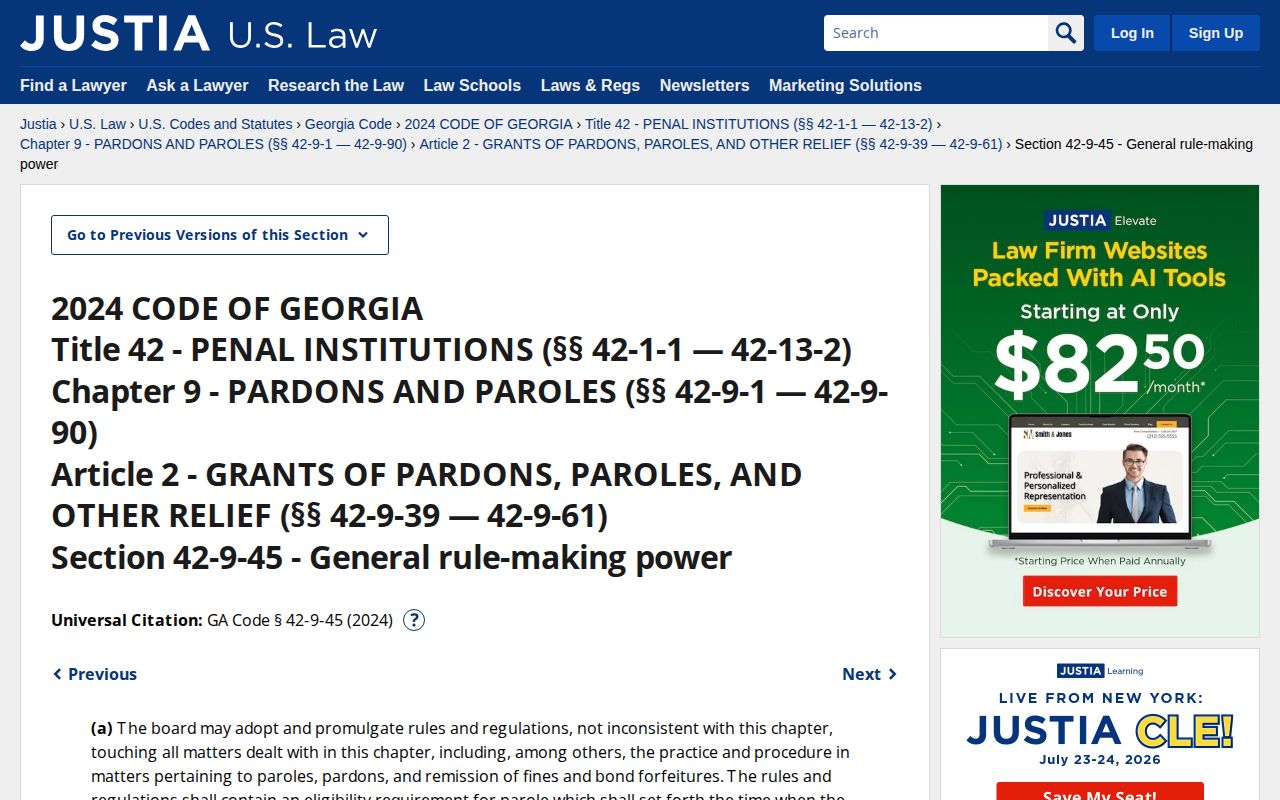
That law supplies the general eligibility framework, while the sentence, offense category, Board rules, and case decision determine the real Colquitt County parole path.
Colquitt Probation Office Detail
Colquitt County has a concrete local supervision route. The official DCS Moultrie location page describes a virtual office serving Colquitt County. The county sheriff page also places DCS probation and parole in the jail courtroom lobby. Together, those sources show why a person may leave the jail or a state institution but still have a local reporting connection. The virtual-office label also makes it wise to call before trying to visit a physical site.
Moultrie DCS Virtual Office
Service area: Colquitt County
Mail: P.O. Box 1792
Moultrie, GA 31776
Phone: (229) 456-8059
Coordinating Chief: Melanie Hasty
DCS headquarters lists a general contact number of (678) 783-4337 and weekday office hours from 8:00 a.m. to 5:00 p.m. Eastern. Local case questions should start with Moultrie. The office can help route supervision questions, but a caller should not assume staff can disclose every part of a file. The court order remains the core source for probation terms, while the Board record establishes parole decisions.
Note: Because Moultrie is listed as a virtual office, call the official number before planning an in-person visit.
Colquitt Supervision Violations and Warrants
An absconder is a person alleged to have stopped reporting or left supervision without permission. That label should come from an official source. The research found no sheriff-published Colquitt County absconder list. A missing local list proves nothing about a named person. Check Parolee Search, DCS, the court docket, and sheriff warrant records through their proper channels. For probation, a court may issue a warrant or hold a revocation proceeding. For parole, Board rules govern the violation and revocation process.
Conditions vary by case. They can include reporting, travel limits, program participation, financial duties imposed by the court, and compliance with the law. A suspected violation does not by itself show that parole or probation has ended. It can lead to continued supervision, changed conditions, a warrant, arrest, or revocation. Revocation means the supervising authority has formally withdrawn community status after the required process. Someone who was released can therefore return to custody later without changing the accuracy of the earlier release record.
Colquitt Reentry Supervision Landscape
Post-release contact is unusually visible in Colquitt County's official local material. The Colquitt County Sheriff's Office page includes a DCS block under its jail information and identifies probation and parole as being in the jail courtroom lobby. That connection gives families and released people a local handoff point when a jail or prison record says supervision follows release.
The handoff depends on the sentence. A state parolee moves from GDC confinement to DCS supervision after a Board release decision. A person on felony probation moves from the sentencing order to DCS. A misdemeanor case may remain tied to State Court, Magistrate Court, or another probation provider. Colquitt Superior Court generally handles felony matters, while State Court often handles misdemeanor and traffic criminal cases. Finding the court first can prevent the wrong agency from being asked to interpret a sentence it did not impose.
This local landscape also separates release from reentry. Release marks the end of a custody event. Reentry is the return to community life, which may include reporting and programs. DCS is central only when the sentence calls for its supervision. A person whose sentence fully ended may need a discharge record, not an active supervision contact.
How Colquitt Supervision Ends
Supervision ends through a formal event, not merely the passage of an estimated date. A parole term may end with sentence completion or a Board discharge. Probation generally ends under the court's judgment, subject to any lawful amendment, early termination, revocation, or completion entry. The best proof is an order, discharge record, or official status from the agency that controlled the term.
Ask for the exact document when certainty matters. For parole, that may be a Board discharge order or a verified parole status. For probation, request the court docket and completion or discharge entry. Georgia's records framework permits a specific written request, though exemptions and redactions may apply. Keep the request narrow: name, case or offender number, supervision type, and the date range. If a public lookup still shows an old status, provide the discharge document to the source agency and ask whether its public record has been updated.
Note: Release from confinement and discharge from supervision are separate events and may have different official dates.