
Colquitt Projected Release Date Meanings
A projected date is an estimate or planning field. It is not the same as the timestamp created when someone walks out or transfers. At Colquitt County Jail, a person awaiting trial often has no set release date. Bond may be posted, a court may alter the conditions, charges may be resolved, or another authority may lodge a hold. A person serving a county sentence may have a calculation based on the judgment and jail credit, yet no public web field was found for that date.
State prison records use more precise terms. A Maximum Release Date, or MRD, relates to the calculated end of a state sentence. A Tentative Parole Month, or TPM, is the month when the Parole Board expects to complete final review and possibly set a parole release date. An actual release date records what happened. A discharge date can mark the end of a sentence or supervision obligation. Reading the label prevents a TPM from being reported as a guaranteed day of release.
- Projected date
- An estimated date that may change before release.
- TPM
- The Tentative Parole Month for final Board review, not a promise of parole.
- MRD
- The Maximum Release Date used in state sentence calculation context.
- Actual release
- The recorded date and time custody ended at a specific facility.
- Detainer
- A request or hold from another authority that can prevent direct community release.
Find Colquitt Projected Release Dates
Start by asking where the person is held and why. The county jail, a GDC prison, federal custody, and immigration custody use separate systems. The Colquitt County Correctional Institution holds state offenders, even though it is locally located. Its release path runs through GDC and the Parole Board. Colquitt County Jail handles local detention and county jail sentences, so its path runs through the jail record and court file.
- Confirm the current facility and whether the person is awaiting trial or serving a sentence.
- For county jail custody, obtain the sentencing or bond order from the correct Colquitt court.
- Ask the jail to identify any calculated date, jail credit, hold, or transfer that affects release.
- For a state sentence, search GDC Find an Offender by name, GDC number, or other known identifiers.
- Record the status, facility, sentence, and each visible date with its exact label.
- Use the Parole Board's TPM tool for parole timing and Parolee Search after release.
- When dates conflict, request written confirmation from the court, GDC, Board, or holding agency.
A person already released needs an actual release record, not a prediction. The Colquitt County released inmates search separates the county jail, GDC, court, and federal confirmation routes. If an alert is needed before the expected event, a person-specific VINELink Check can report a custody change when the relevant feed participates.
Note: Record every date exactly as labeled because tentative, maximum, parole, and actual release dates have different meanings.
Colquitt GDC Release Date Fields
GDC Find an Offender is the statewide source for adults who served state sentences. It is not the normal source for someone held only in Colquitt County Jail on local charges. Search by a full legal name and use ID, case number, age, date of birth, physical identifiers, county of conviction, and sentence details to separate similar records. A released state offender may remain searchable after leaving a facility.
| GDC field | How to use it | Limit |
|---|---|---|
| GDC number | Match the person across correctional records | Do not substitute a county booking number |
| Status | Distinguish current custody from a released or discharged state record | Verify if the display conflicts with another official source |
| Facility | Identify current or last state placement when shown | No facility does not reveal the whole release path |
| Sentence and offense | Connect date fields to the controlling state sentence | Court amendments may require a records check |
| Release or maximum date | Read the date under its exact system label | It can differ from a parole date or actual event time |
GDC states that its public data may not be complete and directs factual verification to Inmate Records and Information, P.O. Box 1529, Forsyth, GA 31029. That written path matters when a projected date will be relied upon or when the screen has changed. The image below comes from the official GDC offender search entry.
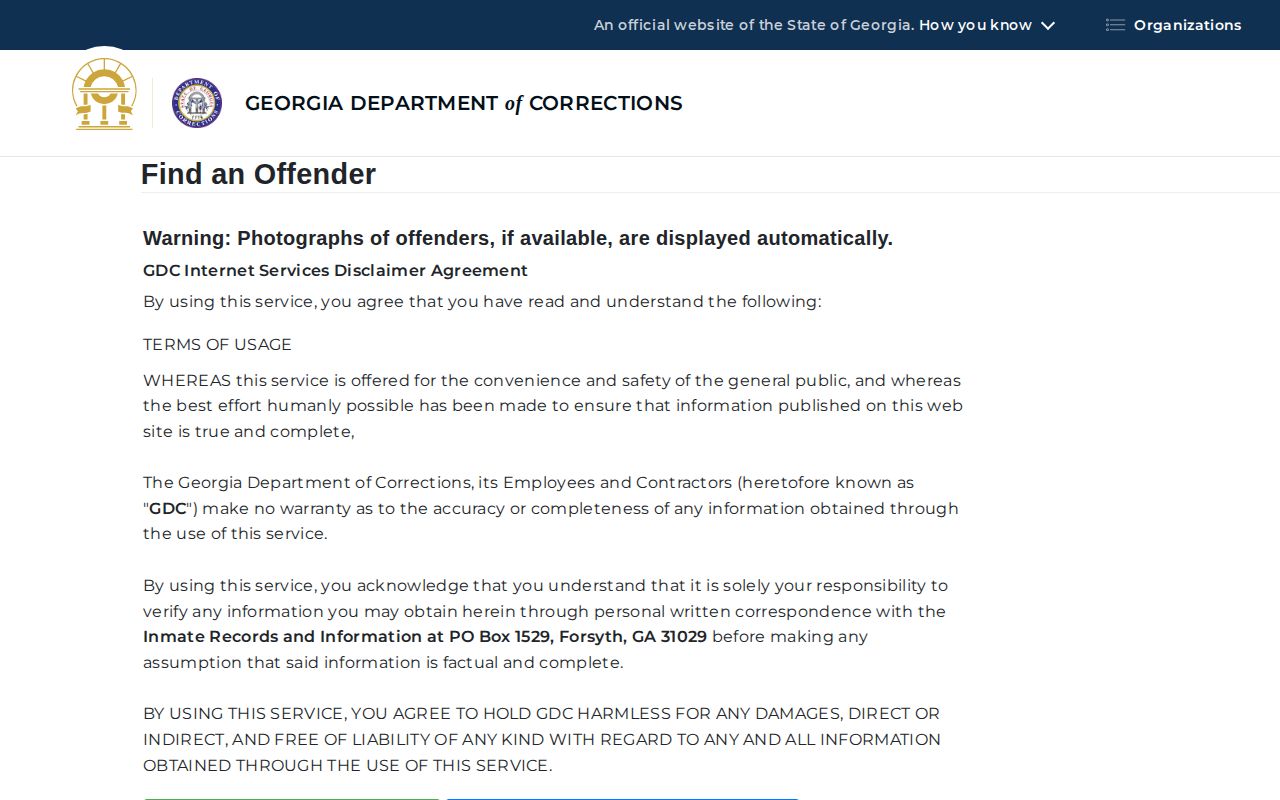
The disclaimer and search entry show why the public result should be paired with identifiers and written agency verification when the exact state release date matters.
Colquitt TPM and Parole Timing
The State Board of Pardons and Paroles defines TPM as the month when it will complete final review and, when appropriate, set a parole release date. Good conduct is required. Some cases also have program preconditions. Misconduct can cause postponement or cancellation. The Board may reconsider and change a decision at any point before release takes effect.
Georgia's general parole eligibility law, O.C.G.A. § 42-9-45, generally places misdemeanor consideration after six months or one-third of the sentence, whichever is greater, and felony consideration after nine months or one-third, whichever is greater. Statutory exceptions matter. Serious violent felony rules, mandatory minimums, recidivist provisions, life sentences, and offense-specific categories can alter or bar the general path. Eligibility means the Board may consider the person. It does not mean release occurs on the first eligible day.
The Board's decision guidelines consider offense severity and risk factors for eligible non-life cases. A majority vote controls a clemency decision. The Board may set a future TPM or deny parole. Its public parole process also says few eligible people receive parole at the first statutory eligibility date. For someone at Colquitt County Correctional Institution, the right sequence is GDC status, TPM if applicable, a final Board decision, then DCS verification if release leads to parole.
Colquitt PIC Release Date Credits
Georgia's Performance Incentive Credit program, known as PIC, is the most relevant state earned-credit path in the research. The official GDC PIC program says eligible offenders may earn points through the reentry case plan, added education or vocational work, and approved detail or work assignments. Up to 12 points may be accumulated, with a possible one to twelve months applied to a TPM or MRD. One point may correspond to one month in that program's framework.
PIC is not automatic release. Some groups are excluded, including people with death sentences, sentences of two years or less, non-parole-eligible or mandatory-minimum offenses identified by the program, and life sentences. GDC administers program participation, while the Parole Board remains involved in parole decisions. Georgia's work incentive credit rule, Ga. Comp. R. & Regs. 125-3-7-.01, also addresses institutional achievement, work, and behavior credits that may be reported for parole consideration.
The official program page appears in the manifest image below. It is linked through the GDC Performance Incentive Credit source.
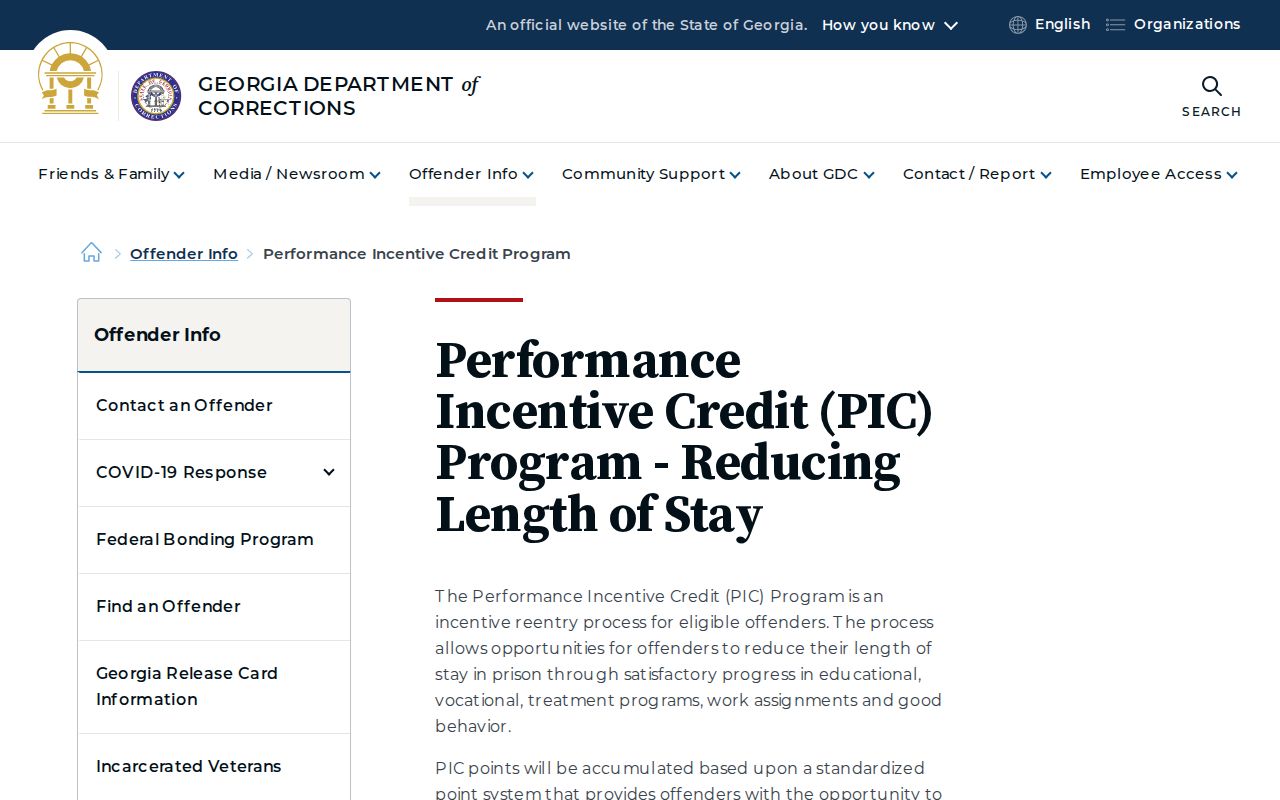
The program can alter a tentative or maximum date for an eligible state offender, but the actual release still depends on the full sentence and agency decision.
Note: An earned credit may adjust a state date field, but it does not override a mandatory sentence rule or detainer.
Colquitt County Sentence Channel Sweep
No Colquitt-specific county good-time policy or weekend-release rule was found in the official research sweep. Publishing a local formula would be unsupported. For a county jail sentence, use the sentencing order, jail-credit notation, and jail calculation. The sheriff page gives the jail number, (229) 616-7430. The Clerk page gives (229) 616-7420 and covers Superior, State, and Juvenile Court records, while Magistrate Court has a separate county channel.
The channel depends on the stage of the case. A pretrial detainee may leave after bond, recognizance, dismissal, or another court order, none of which creates a fixed sentence-end date in advance. A sentenced jail term may be changed by corrected jail credit, an amended order, or a hold. A transfer to GDC, another county, federal authority, or ICE ends Colquitt County Jail custody but does not necessarily end custody as a whole.
Ask the jail or Clerk for the exact calculation instead of doing calendar math. A focused request should identify the person, case or booking number, sentencing date, term, jail credit, projected end date if maintained, holds, and later amendments. The court judgment is the legal starting point. The jail record supplies the custody event. If the person moves into state custody, GDC becomes the controlling date source.
Why Colquitt Release Dates Change
A date can change for a legal reason, a correctional decision, or a data update. The change should be traced to its source. A court can correct a sentence or jail credit. Another authority can file a detainer. The Parole Board can advance, postpone, cancel, or deny parole. GDC can apply or remove eligible program credit based on the governing rules. Program completion and disciplinary reports can affect TPM review. A federal sentence can also be recalculated under federal law.
| Change | Possible effect | Source to check |
|---|---|---|
| Sentence amendment | Moves the legal end date | Sentencing court |
| Jail credit correction | Adds or removes credited confinement time | Court order and jail calculation |
| Bond posted or revoked | Causes release or return to custody | Court and county jail |
| Detainer or hold | Prevents direct community release | Holding and requesting agencies |
| Board decision | Advances, delays, cancels, or denies parole | Parole Board |
| PIC or conduct change | May alter TPM or MRD for an eligible person | GDC and Parole Board |
| Feed lag | Leaves an older date visible for a time | Originating agency record |
Georgia does not have one universal 85 percent rule. The serious violent felony statute, O.C.G.A. § 17-10-6.1, imposes mandatory minimum and parole limits for listed offenses. Separate Board guidelines can recommend high percentages for some severity and risk levels. The exact rule depends on the conviction statute, offense date, sentence, recidivist status, parole eligibility, credits, and Board decision. Use the actual judgment and official calculation.
When the expected day arrives, check again. A projected date may remain useful for planning, but the release entry is the final custody record. If the person instead transfers, request the destination and continue with that agency. Preserve the old forecast and the new actual date because they answer different questions.
Note: A date change is not proof of release or misconduct; verify the cause through the agency that controls the field.